
Fed Raises Interest Rates to 3.75%-4.00%, First Hike Since 2023
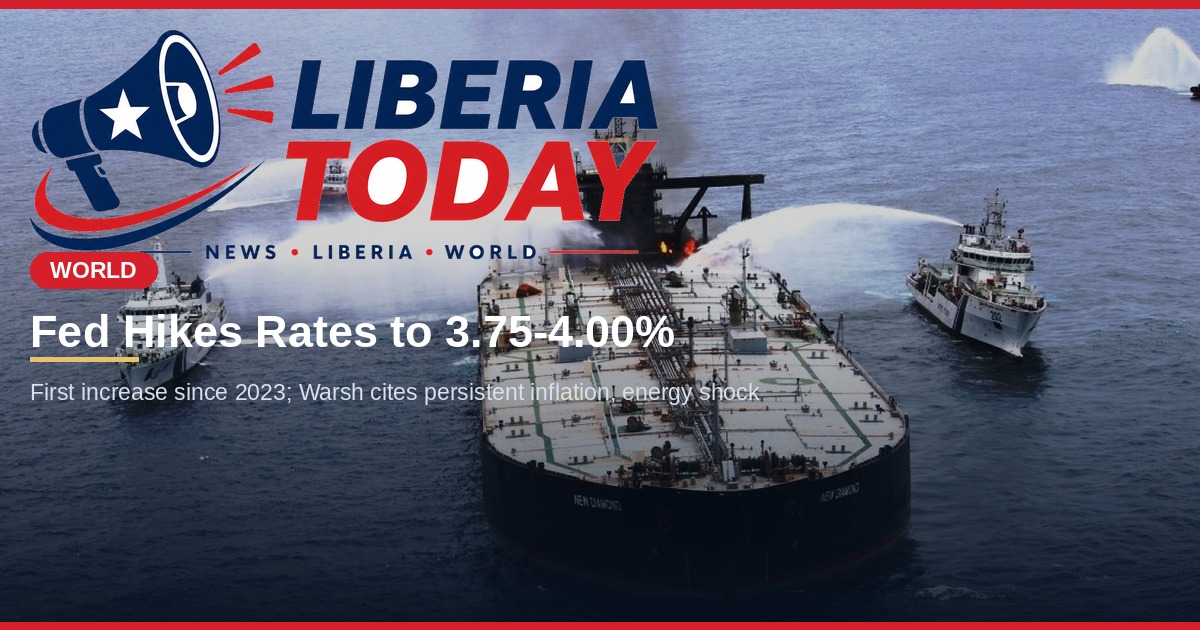
Indian Coast Guard vessels douse a fire aboard the tanker MT New Diamond off Sri Lanka in September 2020 (file photo, unrelated incident) - illustrative of a tanker fire, not the current Middle East tensions. Photo: Indian Coast Guard, GODL-India, via Wikimedia Commons
The Federal Reserve unanimously raised its benchmark rate a quarter point to 3.75%-4.00%, its first increase since July 2023, with Chair Kevin Warsh saying "inflation is the problem" as Middle East tensions keep oil prices elevated.
The Federal Reserve's Federal Open Market Committee voted unanimously on Wednesday to raise its benchmark interest rate a quarter point to a range of 3.75%-4.00%, ending a three-year stretch without a hike and following through on the credibility-driven move markets had anticipated ahead of the meeting. Chair Kevin Warsh left little ambiguity about the reasoning, telling reporters that "inflation is the problem. Stable prices have been the problem for, now, more than five and a half years."
The Fed's updated projections show most officials, 12 of 18, expect one more rate hike before the end of 2026, with rates then projected to hold steady through 2027. Headline inflation is now projected at 3.7 percent, up from a previous 3.6 percent estimate, with core inflation at 3.4 percent; officials do not expect to reach the Fed's 2 percent target until sometime after 2028. Recent data showed core prices accelerating to a 0.3 percent monthly pace in August, reinforcing the case for action.
Middle East tensions, particularly disruptions tied to the Strait of Hormuz, continue to keep oil prices elevated and are a central driver of the inflation outlook the Fed is responding to. Warsh emphasized that the committee believes it can address inflation without derailing the labor market, noting the economy remains at full employment with unemployment at 4.1 percent.
For consumers, a higher federal funds rate typically feeds through to higher costs on mortgages, credit cards and other variable-rate borrowing, though the exact pass-through depends on the specific lender and product. With another hike already penciled in for later this year and the 2 percent inflation target pushed out beyond 2028, Wednesday's decision signals the Fed expects to keep leaning against inflation for a while yet, energy prices in the Gulf permitting.