
Liberia Crosses $1 Billion in Domestic Revenue, But Opposition Says Ordinary Liberians Don't Feel It
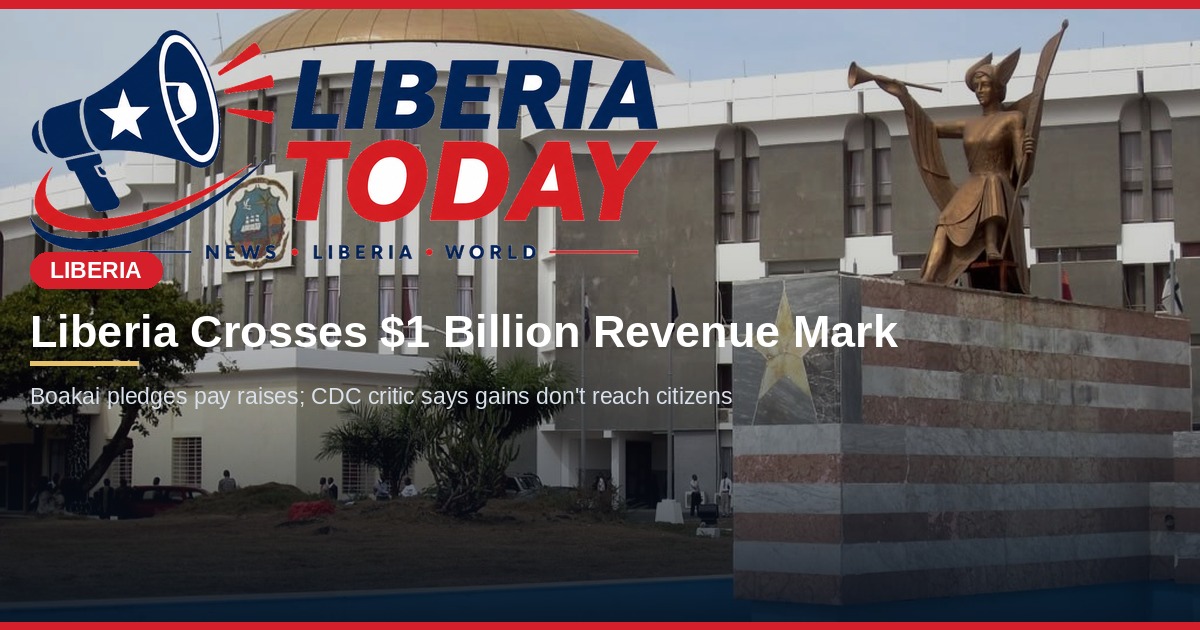
The Capitol Building in Monrovia, seat of Liberia's legislature (file photo, illustrative). Photo: David Stanley, CC BY 2.0, via Wikimedia Commons
The Liberia Revenue Authority confirms Liberia has passed $1 billion in domestic revenue for the first time, a milestone President Boakai celebrated with pay pledges for public servants, but a CDC diaspora official says the gains aren't reaching ordinary citizens.
The Liberia Revenue Authority has confirmed that domestic revenue collection for fiscal year 2026 has crossed $1 billion for the first time in the country's history, closing the roughly $45 million gap reported just days earlier. President Joseph Boakai marked the milestone in a national address, framing it as validation of his administration's ARREST Agenda and pledging that "behind every dollar stands a Liberian."
To back that pledge, Boakai announced salary adjustments for more than 23,000 public servants and the formal placement of 3,400 volunteer teachers and healthcare workers onto the government payroll, moves aimed at converting the revenue milestone into visible benefits for public-sector workers who have long complained about being paid late or not at all.
The celebration has not gone unchallenged. Matthew Young, a member of the opposition Congress for Democratic Change's US-based Diaspora Cyber Team, argued that "the revenue raised/collected to that of the life of ordinary Liberians it is a complete opposite," accusing the government of "celebrating raw revenue figures without demonstrating real impact." His sharpest criticism targeted budget allocation, claiming that "eighty percent of that revenue goes back into recurrent expenditure for the government to run, instead of prioritized social impact programs to lift our population out of poverty."
The dispute captures a recurring tension in Liberian politics: strong headline economic numbers running into public frustration over whether growth is actually reaching households. Boakai's administration will need the newly-funded salary increases and payroll formalizations to visibly materialize in the coming months if it wants to blunt the CDC's "no one to celebrate in front of" framing before it hardens into a durable political narrative ahead of the next election cycle.