
Senator Kogar Condemns AI-Manipulated Images of VP Koung, Presses for Airport Clarity
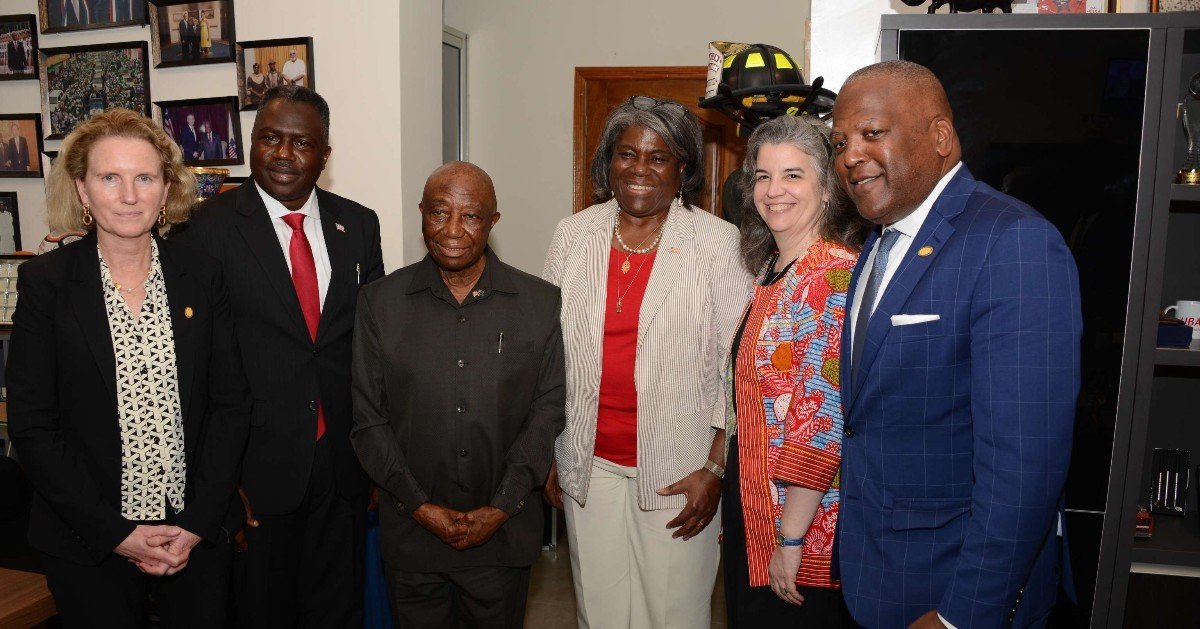
Vice President Jeremiah Koung meets a US delegation including Ambassador Linda Thomas-Greenfield in January 2024 (file photo). Photo: U.S. Embassy Monrovia, public domain, via Wikimedia Commons.
Nimba County Senator Samuel Kogar has condemned AI-generated and manipulated images circulating online that portray Vice President Jeremiah Koung in degrading situations, and called on the Foreign Ministry to clarify what happened at Brussels Airport.
Nimba County Senator Samuel G. Kogar has publicly condemned what he described as a growing practice of creating and circulating AI-generated or manipulated images that portray Vice President Jeremiah Kpan Koung in humiliating and degrading situations. "I strongly condemn the growing practice of creating and circulating AI-generated or manipulated images that portray our national leaders in humiliating and degrading situations," Kogar said, calling on those sharing the content to stop and arguing that political disagreements should never justify demeaning digital attacks on public officials.
The images surfaced amid an unrelated controversy over Koung's recent transit through Brussels Airport, where reports claimed he was pulled aside for heightened security screening on his way to the IAEA's 70th General Conference in Vienna. Koung has disputed those accounts, insisting he used the standard passenger route and describing the stopover as "uneventful," with no shoes or jacket removed during screening.
Kogar used his statement to press the issue further than Koung's own denial did, calling on Liberia's Ministry of Foreign Affairs to provide an official account of the airport incident and to clarify whether proper diplomatic procedures were followed for a sitting vice president's travel. That request leaves the underlying factual question, what actually happened at the screening point, still unresolved by anyone outside Koung himself.
The episode captures a newer and messier front in Liberian political disputes: even as officials spar over the facts of a foreign-travel incident, fabricated visual content has entered the fray as its own distinct harm, one that a single condemnation from a sympathetic senator is unlikely to slow. With AI image generation now trivially accessible, Kogar's appeal to restraint is more a marker of concern than a mechanism for enforcement, and it says nothing about who is producing the images or why, a gap that will need to close before the Foreign Ministry's requested clarification can do any good on either front.